

By Daniel Lancaster, CFA® | The Wealth Expedition
When starting your own business, one of the first decisions you'll make is which of two types of entrepreneurs you will be.
Many people don't even realize they're making this decision—it's often subconscious. But the implications for risk vs reward will eventually make themselves known in the real world.
This goes beyond legal structures, marketing, pricing, or even the product itself.
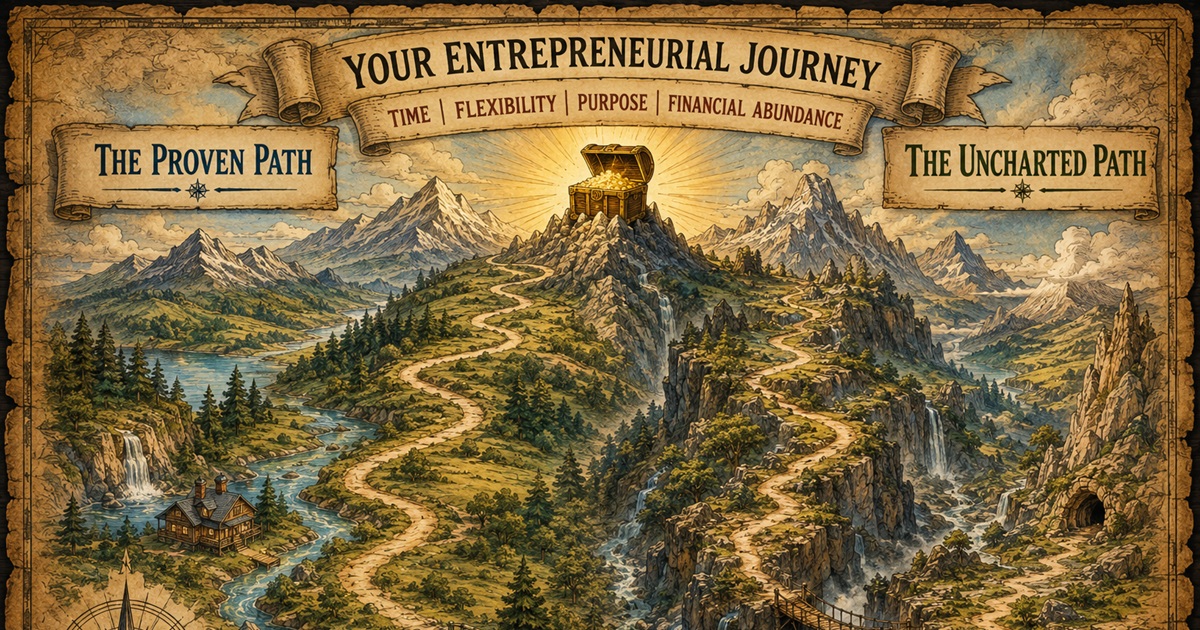
The first type of entrepreneur follows a path that already exists.
The second type creates a path that must first be defined and explained.
Neither path is easy. Both can lead to extraordinary entrepreneurial success. However, they involve very different risks, rewards, and skill sets.
The Defined Entrepreneur
The first of the two types of entrepreneurs is what I'll call the Defined Entrepreneur.
This entrepreneur operates within a category that already exists in the minds of prospective customers.
You are a:
- Financial advisor
- Plumber
- Electrician
- Landscaper
- Photographer
- Mechanic
- Author
- Dentist
- Attorney
When someone asks what you do, they immediately understand the general nature of the service.
Certainly, there may be differences in quality, specialization, pricing, and customer experience, but when you say, "I am this," people generally understand with little explanation necessary.
The market already exists.
The demand already exists.
You are not guessing or theorizing that a market may exist. It does exist. You only have to get a slice of the pie by being the best at serving your specific niche.
Customers already understand the value proposition.
This dramatically reduces entrepreneurial risk.
You don't need to convince people that the category should exist. You only need to convince them that you are the right provider for them specifically.
This is why many successful businesses are built around relatively ordinary services delivered exceptionally well.
A skilled plumber who builds a strong reputation can create a highly profitable company.
A financial advisor who develops expertise and trust can build a thriving practice.
A landscaping company can grow from a single truck into a multi-million-dollar operation.
The category was already defined. The entrepreneur simply entered the market and executed effectively.
The Advantages of the Defined Path
The primary advantage of the Defined Entrepreneur is predictability.
- Customers understand what is being offered.
- Competitors provide a roadmap.
- Pricing models are visible.
- Marketing channels are easier to identify.
This does not mean success is easy. Far from it.
Most businesses still fail due to poor execution, weak management, inadequate capital, or lack of demand.
However, the entrepreneur is not simultaneously trying to educate the market about an entirely new concept.
The challenge becomes operational excellence, and the rewards can still be enormous.
Many of the wealthiest entrepreneurs in the world built businesses that improved existing products, services, or processes rather than inventing entirely new categories.
The Defining Entrepreneur
Among the two types of entrepreneurs, the second path is what I'll call the Defining Entrepreneur.
This entrepreneur is not merely entering a market—they are defining one.
When people ask what they do, the answer often requires explanation beyond a title.
Consider a simple example.
Imagine twenty years ago someone said:
Today, most people immediately understand the concept.
At the time, however, people may have responded:
"No."
"A restaurant?"
"Not exactly."
"A grocery delivery service?"
"Not really."
The entrepreneur wasn't fitting neatly into an existing category.
They were creating a new business model.
Before subscription boxes became popular, entrepreneurs had to explain why customers would pay to receive curated products each month.
Before home-sharing platforms like AirBNB and VRBO existed, people questioned why anyone would stay in a stranger's home.
Every major business innovation begins with the need to define a problem that many don't even recognize exists, and to communicate the value of a solution in a totally new way.
That's because new ideas don't fit neatly into old boxes.
Before committing substantial resources to a new concept, it's wise to validate that the opportunity actually exists. Understanding how to validate a business idea is one of the most valuable skills an entrepreneur can develop.
The Advantages of the Defining Path
Why would anyone choose the more difficult path?
Because of the two types of entrepreneurs, the second path offers the possibility of outsized profits due to first-mover advantage. Because few competitors exist initially, entrepreneurs may enjoy unusually high profits for a period of time.
When a market opportunity becomes obvious, competitors enter the market. Prices fall, margins compress, and customers gain more options.
Over time, those early extraordinary profits often become more ordinary. But if the idea caught on, and you executed strategically, the first mover advantage often pays off for years, and even decades, due to the foundational recognition of your brand name among the earliest and most experienced providers.
The opportunity can be enormous. But so can the risk.
The Challenge of Defining a New Category
The Defining Entrepreneur faces a problem the Defined Entrepreneur does not.
They must first explain why the business should exist at all.
This is where many innovative ideas fail.
The entrepreneur sees value. Customers may or may not. At least not yet.
A brilliant invention is worthless if people cannot understand its benefits or the problem it solves.
Either the market embraces the concept or it doesn't.
Either the entrepreneur successfully defines the category or competitors never arrive because demand never materializes.
Unlike established businesses, there may be no existing roadmap.
The entrepreneur must simultaneously act as:
- Technician
- Manager
- Entrepreneur
- Inventor
- Educator
That is a difficult combination to master.
Two Types of Entrepreneurs — Which Path Is Right for You?
Neither path is inherently better.
The appropriate choice depends on your personality, resources, and goals.
- You value greater predictability.
- You prefer proven business models.
- You want lower entrepreneurial risk.
- You possess specialized technical skills.
- You enjoy improving existing systems.
- You have an eye for identifying problems others ignore.
- You enjoy experimentation.
- You are comfortable with uncertainty.
- You possess creative and inventive tendencies.
- You are willing to educate a market.
In many cases, entrepreneurs begin on the first path before gradually moving toward the second. The early momentum of the first opens up opportunity to experiment with the second.
Innovation doesn't always require creating an entirely new industry.
Sometimes it simply means discovering a better way to serve a specific group of people.
The Real Goal
Entrepreneurship is ultimately the process of creating value.
Some entrepreneurs create value by serving existing demand exceptionally well.
Others create value by discovering opportunities that nobody else has recognized yet.
The question isn't which path is objectively better.
The question is which path best aligns with your strengths.
Understanding which of the two types of entrepreneurs defines you best may be one of the most important business decisions you ever make.
Your Next Step on the Wealth Expedition
Choosing the right business opportunity is one of the most important decisions an entrepreneur can make. Whether you're considering a proven business model or exploring a new idea that doesn't fit neatly into an existing category, success often begins with thoughtful planning, testing, and execution.
Here are a few ways to continue building your entrepreneurial journey:
1. Join The Wealth Expedition Membership
If you're interested in entrepreneurship as a path toward greater freedom, flexibility, purpose, and financial opportunity, the membership provides a structured framework for thinking strategically about business ownership.
Inside, you'll learn how business creation fits into a broader wealth-building plan that includes investing, financial planning, and intentional lifestyle design.
2. Get Personalized Financial Planning
Starting or growing a business often raises important financial questions.
Through personalized financial planning, we can evaluate how a business opportunity fits within your overall financial picture and determine an approach that balances opportunity with prudent risk management.
3. Subscribe to the Weekly Newsletter
If you're still exploring entrepreneurship, investing, and wealth building, the weekly newsletter is a practical next step.
Each week, I share practical insights on entrepreneurship, risk management, budgeting, investing, and building financial resilience — so you can make clear decisions with long-term consequences in mind.