

By Daniel Lancaster, CFA® | The Wealth Expedition
Entrepreneurship can appear mysterious and threatening to those who have never seriously considered blazing their own path.
It's easy to assume that success comes from building the best product, the most polished website, or the most complete service offering with a science-backed sales funnel. So they spend months—or even years—designing something they hope the market will love.
Then reality hits—and no one buys it.
The real skill in entrepreneurship is not building big or building fast. It's not even scaling fast. It's knowing how to validate a business idea before you commit meaningful time, money, or energy.
Because the validation stage is often the one that makes or breaks a company. If you can break through the validation stage, the execution stage is a much more enjoyable (and profitable) ride.
Why Most Entrepreneurs Overbuild Too Soon
It's easy to look at successful companies and feel intimidated.
Their full product ecosystems, supported by sleek websites with flawless design and automated sales funnels, present the appearance of an unbreachable moat. After all, they have years of brand-building and marketing behind them—and websites that have built significant domain authority which simply compounds that social presence.
It's natural to think: How could I ever compete with that?
But that comparison is misleading.
When you're learning how to validate a business idea, you are not competing with those companies yet. You are not trying to match their scale. You are simply trying to answer one question:
Everything else is secondary.
The Gold Miner Approach to Business
A helpful way to think about entrepreneurship is to imagine yourself as a gold miner.
You are not digging a massive chasm hoping you eventually strike gold.
Instead, you:
- Start small
- Test different areas
- Look for signals of value
- Increase effort only when you find evidence
This is exactly the same process for how to validate a business idea.
You are not building a full mine before you find gold.
You are chipping away at small sections of the ground with a low-cost, hand-wielded pickaxe, looking for signs that something valuable exists underneath. Only when you see sufficient evidence of gold do you begin to expand operations.
Most entrepreneurs do the opposite—they build the entire mine first and only later discover there was no gold.
Or if they do find gold, they build the expanded operations with them at the center—the bottleneck upon which everything else depends. This is the technician trap.
Both are mistakes that can and should be avoided.
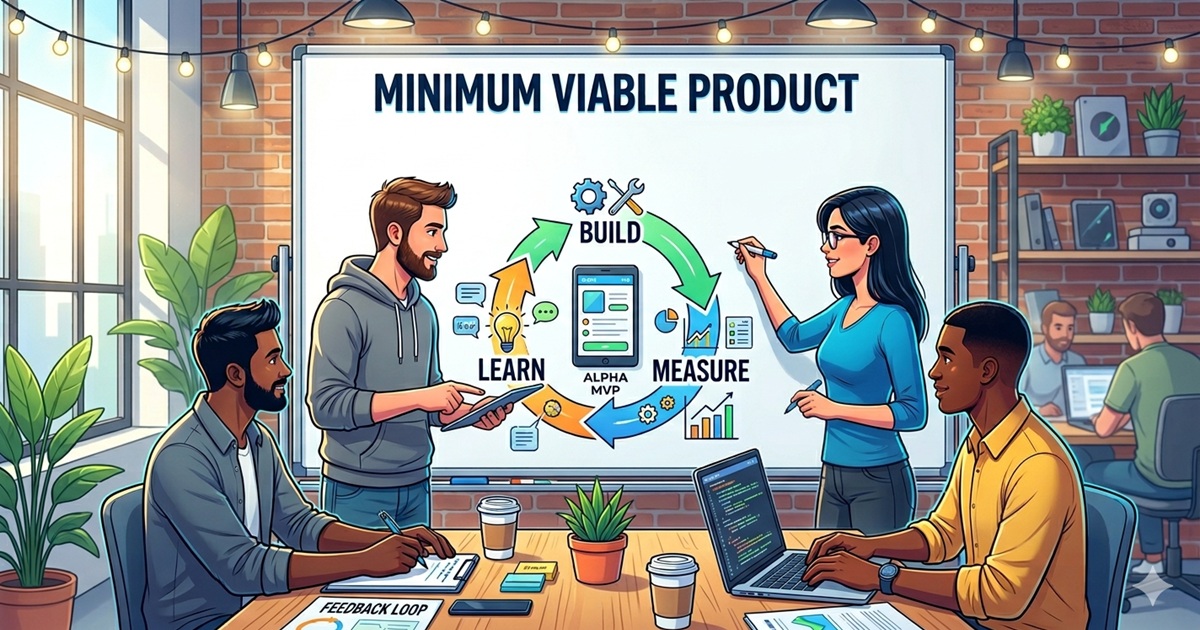
What a Minimum Viable Product Really Means
Here's what a minimum viable product (MVP) is not.
It is not a cheap version of your final product or a rough prototype.
Rather, an MVP is simply the smallest possible test that validates whether your specific solution solves a real, singular problem for real people.
That's it.
When you understand how to validate a business idea, you begin with defining the MVP as your primary aim, using it as a tool to first determine the demand and price point(s) of your idea.
Step 1: Identify Real Customer Pain Points
Every strong business starts with a painful problem.
If the problem is weak, the business will be weak.
When thinking about how to validate a business idea, your first job is to observe.
Look for:
- Problems people complain about repeatedly
- Frustrations in online forums
- Inefficiencies in existing solutions
- Workarounds people already use
Strong businesses are built on problems that are:
- Frequent
- Expensive (emotionally or financially)
- Urgent
- Underserved
This is where customer pain points matter most.
It's important to recognize that not all problems are financially expensive—some are emotionally expensive.
In many cases, people don't even perceive these issues as urgent problems. They may tolerate them for long periods simply because they don't seem worth their time or attention. In other words, the cost is not monetary—it's psychological effort, inconvenience, or mental friction.
Because of this, they delay solving the problem themselves.
However, once the inconvenience or hidden cost is clearly brought to their attention, their perception often shifts. What once felt "minor" or "manageable" is now seen as something worth solving quickly.
At that point, they are far more willing to pay someone else to take the problem off their hands.
Step 2: Do Real Startup Market Research (Not Guesswork)
Most beginner entrepreneurs rely on assumptions.
They try mentally to put themselves in the shoes of their target audience. They ask, "If I were someone like x, would I buy?" While that is a start, it's certainly not sufficient for a serious entrepreneur.
Real startup market research is simple and practical.
You can validate demand by:
- Reading forums where your target audience gathers
- Engaging commentors and group members in direct, one-on-one conversation (if possible) to learn more about the problem being discussed and any existing workaround solutions
- Analyzing recurring complaints or questions
- Studying competitors and reading their reviews
- Identifying gaps in existing solutions
You are looking for patterns, not necessarily opinions, at this point.
This step is an essential step for how to validate a business idea, because it removes guesswork and replaces it with real-world data from real people.
Step 3: Define a Niche Before You Build Anything
One of the biggest mistakes in entrepreneurship is trying to serve everyone.
Instead, effective founders use niche marketing principles from day one.
A strong startup business does not aim to be:
- The best for everyone
- The biggest in the market
- The most feature-rich solution
It aims to be:
- The best solution for one specific type of person with one specific problem.
This is central for how to validate a business idea.
Ask yourself:
- Who exactly is this for? (Imagine someone you know)
- What specific problem am I solving?
- Why this group, not everyone?
Step 4: Build the Smallest Possible MVP Test
Once you understand the problem and audience, you move into testing.
A strong MVP development for startups approach might include:
- A simple landing page describing the offer
- A survey asking about willingness to pay
- A pre-sale or waitlist
- A consultation-based version of the service
- A manual "concierge" version of the product
Notice what is missing: full development.
Because validating a business idea is not about building the final product. It's about proving demand exists first.
Step 5: Test Your Idea Before You Build It
This may be the toughest, yet most essential, part of the process.
At this point, you should have received at least a small measure of individual feedback—even if it was simply based on a description of the product or service. Hopefully some test version of the product or service has received positive feedback, which could initially be used (with permission) for marketing purposes. Next comes behavioral proof.
You want to now determine:
- Will people sign up of their own accord?
- Will they commit time?
- Will they pay—even a small amount?
Start small—don't overcomplicate it:
- One conversation
- One pilot user
- One paid test customer
This is the core idea of how to validate a business idea in practice.
Step 6: Iterate Based on Real Feedback
Once you have initial users, your focus shifts to refinement.
A strong validation loop looks like:
- Test
- Learn
- Adjust
- Retest
This is the heart of niche business strategy—improving something specific for a specific audience.
You are not trying to perfect everything. You are trying to identify:
- What actually creates value
- What users ignore
- What needs improvement
- What drives willingness to pay
This is where real product-market fit begins to emerge.
Step 7: Know When You've Found Something Worth Scaling
You've likely validated your idea when:
- People are willing to pay consistently
- Feedback becomes more about refinement than confusion
- Demand starts to repeat without heavy persuasion
- Early users refer others
- You now have statistics for conversion ratios and lifetime value (LTV) of a customer
At this stage, you can confidently say you've completed the early phases for how to validate a business idea.
Now—and only now—do you begin scaling your marketing efforts. You can upgrade and expand systems as demand requires. You can define roles within the business, creating standard operating procedures (SOPs) for what causes the business to run, even if you're the only current employee. This is extremely important to avoid becoming the bottleneck and escape burnout down the road.
Now you better understand your own unique voice. Your MVP clarifies the brand you want to build. And from that, you can more strategically expand your reach and, eventually, widen your product and service offering using the profit margins from the MVP as fuel for more testing and validation.
A Simple Local Example: Validating a Landscaping Business
Let's apply this to a real-world scenario: starting a small landscaping business.
At first glance, it might seem like a fully developed business requires equipment, trucks, branding, a website, and a full list of services. But that would be overbuilding before validation.
Instead, here's how the business validation process would actually work in practice.
Step 1: Identify the customer pain point
You notice homeowners in your neighborhood consistently struggle with:
- Overgrown yards due to lack of time
- Difficulty finding reliable and/or affordable help
- Inconsistent pricing or poor communication from providers
This tells you the real opportunity isn't "landscaping services"—it's reliable, convenient yard maintenance.
Step 2: Define a niche
Instead of trying to serve everyone, you narrow it down:
For example:
- Busy working families within a 5–10 mile radius
- Homeowners who want basic, consistent lawn maintenance
- Clients who value reliability over premium landscaping design
This is your niche marketing focus.
Step 3: Create a minimal MVP
Rather than buying equipment and building a full company upfront, you start small:
- Offer basic mowing and edging services
- Use borrowed or rented equipment if needed
- Keep it limited to one or two service types
- Reach out directly to neighbors or local Facebook/community groups
This is your MVP startup strategy in action—simple, manual, and focused only on proving demand.
Step 4: Test and validate
You offer services to:
- One homeowner for free or at a heavily discounted rate
- One additional customer at a normal introductory price
Now you're looking for real signals:
- Do they book again?
- Do they refer neighbors?
- Are they willing to pay your target price?
This is how to test your business idea in the real world.
Step 5: Iterate before scaling
Based on feedback, you adjust:
- Pricing
- Service frequency
- Communication style
- Service quality expectations
Only once you consistently see satisfied, paying customers do you invest in:
- Better equipment
- Branding
- Marketing
- Expansion
At that point, you've successfully completed the business idea validation process in a real, local setting—before risking significant capital.
The Core Principle: Start Small, Learn Fast, Expand Only With Evidence
The entire process for how to validate a business idea can be summarized as follows:
Everything else is secondary.
Most failed startups don't fail because they couldn't build something impressive. They fail because they built something impressive that nobody needed or knew how to find.
Final Thoughts — How to Validate a Business Idea
Entrepreneurship is not a race to build the biggest or most complex solution.
It is a disciplined process of discovery.
When you understand how to validate a business idea, you gain a major advantage over most founders. You stop guessing. You stop overbuilding. You stop wasting resources.
Instead, you:
- Start with real problems
- Test before you build
- Learn from real users
- Scale only what is proven
The MVP approach is the way to maximize learning while minimizing waste.
And that is how real businesses are built: not in one big leap, but through careful validation, one small step at a time.
Your Next Step on the Wealth Expedition
A successful business rarely begins with a perfect plan. More often, it begins with curiosity, observation, and a willingness to test ideas before committing significant time or money.
Here are a few ways to continue building your entrepreneurial journey:
1. Join The Wealth Expedition Membership
If you're interested in entrepreneurship as a path toward greater freedom, flexibility, purpose, and financial opportunity, the membership provides a structured framework for thinking strategically about business ownership.
Inside, you'll learn how business creation fits into a broader wealth-building plan that includes investing, financial planning, and intentional lifestyle design.
2. Get Personalized Financial Planning
Starting or growing a business often raises important financial questions.
Through personalized financial planning, we can evaluate how a business opportunity fits within your overall financial picture and determine an approach that balances opportunity with prudent risk management.
3. Subscribe to the Weekly Newsletter
If you're still exploring entrepreneurship, investing, and wealth building, the weekly newsletter is a practical next step.
Each week, I share practical insights on entrepreneurship, risk management, budgeting, investing, and building financial resilience — so you can make clear decisions with long-term consequences in mind.