

By Daniel Lancaster, CFA® | The Wealth Expedition
One significant key to changing your relationship to money is understanding "money scripts"—deeply held beliefs about money that shape our financial behaviors, often without us realizing it.
Our relationship with money is shaped by more than income, aptitude, or financial knowledge. Beneath every spending decision, every investment, every financial goal, and every source of stress lies something deeper: our beliefs about money.
And these are often formed during childhood—continuing to develop into early adulthood.
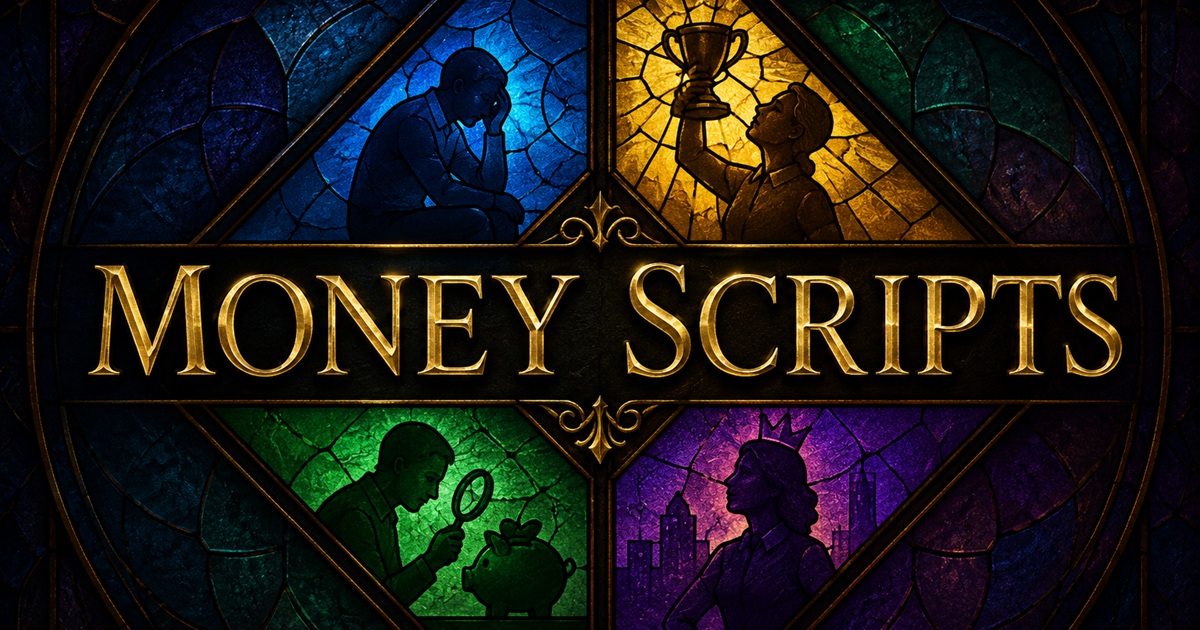
While every person is unique, researchers have identified four common money scripts:
- Money Avoidance
- Money Worship
- Money Vigilance
- Money Status
Do you recognize yourself, or someone you know, in at least a few elements of one or more of these categories?
The Four Money Scripts
Money Avoidance
People with a money avoidance script often view money as something negative, stressful, or overly complicated.
They may believe that wealthy people are greedy, that financial matters are best ignored, or that money simply isn't something they can successfully manage.
It often results from a few different sources:
- A feeling that money is inherently negative, or even evil.
- A sense that it is too complicated or too difficult to achieve to any meaningful degree.
- A concern that if one pays too close attention, they will be stressed out or anxious about their financial situation.
As a result, they may neglect important areas of their financial lives such as budgeting, career advancement, or investing.
The irony is that avoiding money doesn't eliminate financial stress—it often increases it. In the end, it causes this area of our lives to need extra attention.
"For the love of money is a root of all kinds of evils."
-Paul (1 Timothy 6:10)Remember that it is the love of money, not money itself, that leads to evil. Money is a store of value and a medium of exchange. Without it, we would all be back to bartering and trading—creating an ultra-limited society with very few conveniences beyond what a single person could produce.
Even Jesus recognized and taught that investing, and return on investment, was a responsible thing to pursue in all areas of life where God has entrusted something to us—money included.
Money is not the master. It is the servant. It should never take first place in our lives' priorities—or else it leads to great pain to ourselves and often to others.
Money Worship
Money worship is the belief that happiness, fulfillment, or security are always just one purchase, promotion, or paycheck away.
Few people would consciously admit to believing this. Yet many live as though more money will finally deliver the contentment they've been searching for.
This script often shows up as overspending, chronic dissatisfaction, lifestyle inflation, and excessive debt.
Money Worship often stems from such things as:
- Lacking a strong sense of "self" or a deep internal world that is independent of external possessions and actions.
- A fear of never having enough.
- The addiction to a dopamine-rush of buying new things while failing to explore other, more lasting avenues to lasting happiness and joy.
"One's life does not consist in the abundance of his possessions."
-Jesus (Luke 12:15)There is nothing wrong with enjoying the good things of life. In fact, this is an extremely important concept taught by Solomon in Ecclesiastes. The problem arises when we expect material things to fulfill needs they were never designed to satisfy.
Money Vigilance
Money vigilance is often praised because it appears responsible on the surface.
These individuals save diligently, avoid unnecessary debt, and prepare for the future.
Those are good things.
The challenge is that money vigilance can drift into an unhealthy obsession with safety and preparation.
Vacations are postponed. Experiences are delayed. Enjoyment is deferred indefinitely because the future always seems more important than the present.
Money Vigilance can spring from:
- A sense of dissatisfaction with one's career or daily grind.
- A sense of having lost something in the past, or being afraid to lose something from the present.
- Consistent belief that the future will be better, and is significantly more valuable, than the present.
He had sacrificed the present for a future that never came.
The lesson isn't that saving is wrong. The lesson is that life requires balance.
Those who sacrifice every present joy for a future that may never arrive risk losing both the present and the future. And even if the future unfolds exactly as planned, their internal compass is so accustomed to hyper-vigilance that it often becomes difficult to synchronize with the present in order to begin finally enjoying it.
Money Status
The final script is money status.
This is the belief that wealth is a measure of personal worth.
Money Status can emerge from:
- Deeply buried feelings of shame or inadequacy.
- A need to prove oneself for the sake of acceptance or love (even self-love).
- A desire to be perceived as powerful, intelligent or influential.
This script drives people to seek validation through income, possessions, job titles, or net worth.
Money becomes a scoreboard.
The problem, of course, is that money measures many things—but it does not measure human value.
Income can result from talent, hard work, discipline, opportunity, inheritance, timing, or luck. Meanwhile, some of the most valuable contributions to society receive little or no financial compensation.
- Parenting
- Volunteering
- Caring for family members
- Mentoring
- Acts of service
These activities may not generate income, but they create a world of depth and abundance that is worth living in.
"Pride goes before destruction, and a haughty spirit before a fall."
-Solomon (Proverbs 16:18)Our net worth is not our self-worth. Confusing the two is a recipe for disaster.
Can You Change Your Money Scripts?
The good news is that money scripts are not permanent.
The first step is simply recognizing them.
Once we become aware of the beliefs operating beneath the surface, we can begin examining whether they are helping us or hurting us.
What's interesting is that each money script contains a kernel of truth:
- Money avoidance reminds us not to make money our master.
- Money worship recognizes that financial resources do improve certain aspects of life.
- Money vigilance understands the importance of preparation.
- Money status acknowledges that creating value often leads to financial rewards.
Money is a powerful tool. It can create opportunities, provide security, and steward the world in the service of others. But it was never meant to define us, control us, or become the ultimate source of meaning in our lives.