


Investment success is actually quite simple. Almost too simple. The biggest driving factor of your success comes down to asset allocation.
And this article will help you design your personal asset allocation by risk tolerance.
Glossing over this step causes even a mathematically sound investment strategy to fall apart in real life. Investors panic, abandon the plan, or constantly tinker—usually at exactly the wrong time due to common biases. The result is usually unnecessary stress and lower long-term returns.
Designing asset allocation by risk tolerance correctly is the foundation of successful portfolio construction. It determines how your portfolio behaves in good markets, bad markets, and—most importantly—how you behave when uncertainty shows up.
Let's break down how risk tolerance really works, how it connects to asset allocation, and how to design a portfolio you can watch worry-free from a distance.
What is Risk Tolerance
Risk tolerance isn't a single factor. It's a blend of three distinct forces working together:
1. Willingness to Take Risk (Emotional)
This is how you feel when markets move against you. Because how you feel can generally predict how you will act and how you will experience quality of life in the midst of uncertainty.
Can you tolerate a 20% decline without losing sleep—or do you feel an overwhelming urge to sell and "do something"? Remember that those declines aren't just marks on a screen; they're also accompanied by narratives from the media, friends and a social media that make it sound like everything "normal" is falling apart. This makes the numerical uncertainty even more difficult to handle emotionally.
This is psychological, not mathematical. And it matters more than most people admit.
2. Ability to Take Risk (Mathematical)
This is your financial capacity to endure volatility without jeopardizing your goals. Factors include:
- Stable vs unpredictable income
- Emergency savings
- Time until withdrawals begin
- Dependence on the portfolio for living expenses
- Sequence-of-returns risk (how important it is not to have a steep decline in the early years)
Someone with strong cash flow and long time horizons can logically afford more risk—even if they don't love it emotionally.
3. Need to Take Risk (Reality-Based)
This is the least discussed—and most misunderstood—piece.
If your goals require growth to be achieved (for example, retiring comfortably without extreme savings), you may need exposure to risk assets like equities. Conversely, if your goals are already funded, your need for risk may be low—even if your willingness is high.
True investment risk tolerance lives at the intersection of all three.
Why Time Horizon Changes Everything
Risk behaves differently depending on when you need the money.
Short-Term Risk
Over short periods, equity markets are unpredictable. There is only a very slight tendency for markets to end up rather than down on any given day. And even that appears to change slightly depending on recent trends (momentum).
Large swings—both up and down—are common. Even bond markets can experience unexpected volatility, especially when interest rates change quickly.
This makes stocks (and sometimes bonds) unreliable for money you need soon.
Long-Term Risk
Over longer horizons, something interesting happens.
Equity markets tend to converge toward their long-term averages. The range of potential outcomes narrows. While returns aren't guaranteed, they become far more predictable over decades than over months.
Bonds, meanwhile, often show the opposite behavior:
- Lower short-term volatility
- Wider long-term range of outcomes
This is why holding both stocks and bonds helps manage risk—not by eliminating volatility, but by balancing different types of uncertainty across time.
When designing asset allocation by risk tolerance, time horizon plays a significant role.
A Quick Note on Correlation
Correlation measures how two assets move relative to each other.
- High positive or negative correlation: assets move together, either with or against each other
- Low correlation: assets move differently and are not affected the same way by the underlying risk factors
Stocks and bonds historically exhibit low correlation over many market cycles. When one struggles, the other often behaves differently. That interaction is what allows diversification to reduce overall portfolio risk without necessarily sacrificing the same degree of return.
Asset Allocation by Risk Tolerance: High-Level Examples
At the broadest level—ignoring individual sectors, styles, market caps or geographical regions—portfolios are usually built from four categories:
- Equities
- Fixed income
- Alternatives (real estate, commodities, etc.)
- Cash
Here are simplified examples based on risk tolerance alone:
| Risk Profile | Allocation |
|---|---|
| Aggressive | 100% equities |
| Moderate Aggressive | 70% equities / 30% fixed income |
| Moderate | 60% equities / 40% fixed income |
| Moderate Conservative | 40% equities / 60% fixed income |
| Conservative | 100% fixed income |
These are high level reference points, and a portfolio can be a blend of any of these depending on an investor's unique situation.
The right allocation depends on the three components of risk tolerance, and how they interact in your life.
Why Age-Based Rules Fall Short
You've probably heard rules like:
- Subtract your age from 100 to arrive at your equity allocation
- You should reduce risk as you get older
Age does usually influence risk capacity, but it doesn't define risk tolerance.
Two 45-year-olds can have very different portfolios depending on:
- Whether the money is intended as a legacy for beneficiaries or for spending during their lifetime
- How large annual withdrawals will be
- Job security and income flexibility
- Willingness to stay invested during downturns
- Availability of backup income sources
This is why investment risk tolerance by age is an incomplete concept. Age matters—but it's only one variable among many.
Factors That Should Shift Your Asset Allocation
Your ideal design of asset allocation by risk tolerance isn't static forever. It should respond to your life, not just market conditions.
Here are several factors that legitimately push a portfolio more aggressive or more conservative—without changing a single assumption about market returns:
→ Exception: investors using absolute, rules-based hedging strategies such as:
→ If funds are likely to remain invested long-term: more aggressive
Taxes, Income Needs, and Structural Constraints
Asset allocation also depends on the tax status and other rules of the account in which it exists.
In certain tax situations, capital gains may be preferable to dividends or interest—or vice versa. In taxable accounts, this can materially affect after-tax outcomes. If you want a deeper dive, see Know This Before Choosing Dividends, Interest, or Capital Gains.
Other factors may push portfolios toward income:
- Predictable future liabilities
- Trust rules limiting withdrawals to income only
- Desire for steady cash flow regardless of growth
These considerations don't replace risk tolerance, but they shape how it's expressed in a real portfolio.
Historical Perspective Matters
If you want to see how different allocations have behaved historically—both best- and worst-case outcomes—Vanguard provides a useful overview.
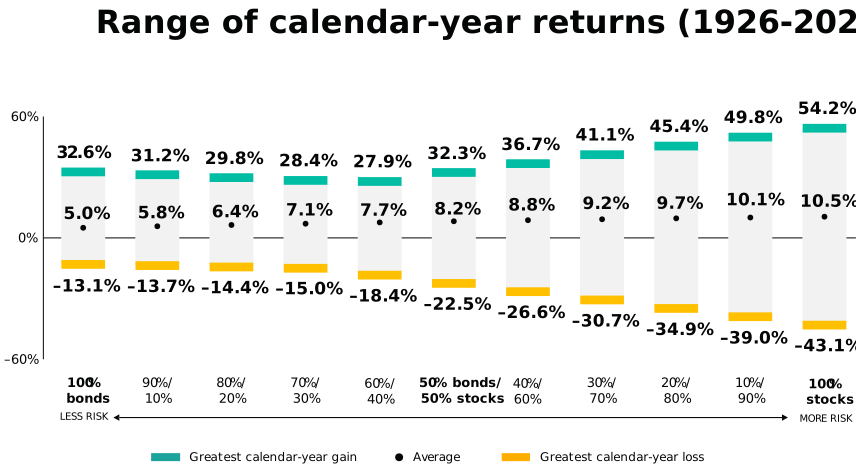
The key takeaway isn't which allocation performed best. It's that every allocation experiences discomfort at some point. The "best" portfolio is the one you can stay invested in through those periods.
Risk Tolerance Is Often Revealed With Experience
Most investors think they know their risk tolerance until markets test it.
Risk tolerance isn't what you say you can handle. It's what you actually do when:
- Markets fall 20%
- Headlines turn apocalyptic
- Friends and coworkers start "going to cash"
- Friends and coworkers start talking about how they doubled their money elsewhere
A portfolio that looks optimal on paper but causes you to abandon it in the midst of fear or greed is functionally incorrect, no matter how elegant the math.
This is why risk tolerance must be observed, tested, and respected.
A Practical Framework for Getting Started
Designing a portfolio that matches your risk tolerance doesn't start at the fund or individual asset level. It starts with clarity from the top down.
- Define your financial goals
- Calculate what you already have saved or invested
- Identify liquidity needs (when withdrawals begin)
- Determine your full investment time horizon (even to the last dollar)
- Take a risk tolerance assessment
- Rebalance regularly to stay aligned
Within The Wealth Expedition, this risk assessment is provided as part of the guided process. If you'd like a guided framework for determining and managing risk, I welcome you to come aboard.
The Real Key to Investment Success
The most important variable in investing isn't microscopic precision. It's broad consistency.
A mediocre strategy executed consistently will generally outperform a perfect strategy applied sporadically. Once your portfolio fits your:
- Willingness
- Ability
- Need
…the only reason to change it materially is if one of those three changes—not because of markets forecasts or recent price movement.
Volatility is not a signal. It's simply the cost of participation.
Refining Allocation (After the Foundation Is Set)
Structuring broad asset allocation by risk tolerance is the most important decision you'll make.
Only after that's appropriately designed does it make sense to refine:
- Market capitalization
- Stock styles
- Sectors
- Individual stock exposure
- Domestic vs international exposure
- Bond duration and quality
- Tactical adjustments based on market cycles
Those topics are explored further in:
- Why Asset Allocation Is So Important for Portfolio Construction
- Investing for a Recession: Building an All-Weather Portfolio
- 4 Investment Strategies for Late-Stage Bull Markets
You may also explore concepts like the Efficient Frontier, which examines how different allocations balance risk and return.
The Big Picture
Think of asset allocation like setting a ship's course across the ocean. This is critical for your Wealth Expedition.
This step doesn't guarantee calm seas—but it ensures you're headed toward the right destination. Fine-tuning may get you there faster or slower, but without a proper heading, speed doesn't matter.
Within The Wealth Expedition, this is the foundational investing step that follows budgeting. Once you understand how to deploy capital first as:
• Savings (emergency and preparation funds)
• Investments (retirement and opportunity funds)
• Then business capital
…you begin designing a system capable of real compounding and real accelerated life change.
Get this right, stick with it, and everything else becomes refinement of an already success-bound financial plan.