


One of the toughest decisions an entrepreneur will ever face is knowing when to pivot in business.
Because of our natural aversion to the idea of wasted time, we prefer to avoid acceptance of "sunk costs." These are costs we cannot get back, but that ended up not returning what we expected.
It's easier to simply work harder and double down, grinding through what we hope turns out to be temporary discomfort.
But the hard question we often don't want to face is when to change direction entirely.
We've all heard the mantra: Never give up. Napoleon Hill famously wrote in Think and Grow Rich:
And he was right.
But here's the nuance most people miss:
It guarantees failure.
Imagine someone obsessively trying to invent a perpetual motion machine powered only by gravity and inertia. No matter how disciplined, committed, or persistent he may be, physics will not bend. His effort, no matter how sincere, is misapplied.
The real skill of entrepreneurship isn't just perseverance.
It's knowing when to pivot in business — and when to push through what Seth Godin calls "The Dip."
The Two Opposing Risks Every Entrepreneur Faces
There are two primary ways failure shows up:
- Pursuing too many opportunities at once without committing deeply to any.
- Pursuing one opportunity that leads to a cul-de-sac or a cliff.
The first leads to distraction and slow business growth because energy is scattered.
The second leads to stagnation — or worse, ruin.
Entrepreneurs often think of risk management in financial terms: insurance, liquidity, diversification. Those are important, but there is another form of risk management rarely discussed:
Directional risk.
Going in the wrong direction, albeit enthusiastically, is one of the greatest risks of all.
Understanding when to pivot in business is not weakness. It is sophisticated business risk management.
The Dip, the Cul-de-Sac, and the Cliff
In The Dip, Seth Godin explains that not all periods of painfully slow progress are created equal.
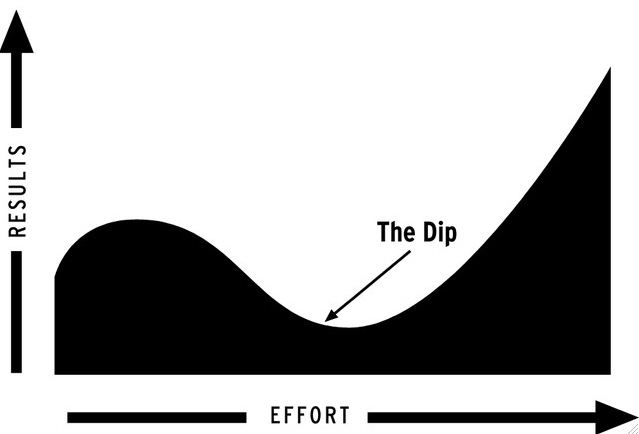
There are three possible scenarios:
The Cul-de-Sac — A situation that will not improve much no matter how long you persist.
The Cliff — A path that leads to serious harm or irreversible loss if you continue.
The problem is that all three feel similar in the moment.
Slow growth feels like failure.
Resistance feels like rejection.
Plateaus feel permanent.
So how do you determine when to pivot in business versus when to persist?
Godin suggests three diagnostic questions.
When to Pivot in Business: The Three-Question Test
1. If I Quit Today, Would It Be Because I'm Panicking?
Emotion is not a reliable strategic advisor.
Many founders ask, "Should I close my business?" in a moment of exhaustion or discouragement. That is rarely the right moment to decide.
Ask yourself:
- Is this fear-based?
- Is this temporary?
- Am I reacting emotionally rather than evaluating the math?
If quitting is purely a panic response, and the forecasts founded in existing evidence tell a more positive story, then you may actually be in The Dip — the uncomfortable moat that keeps competitors out.
Great opportunities are rarely easy. If they were, everyone would seize them.
An excellent way to help clarify the answer to this question is to get a second opinion by an expert in the field. Ideally this person is part of your Master Mind.
2. Can I Be the Best in the World (For a Specific Audience)?
This is the most misunderstood question.
"Best in the world" does not mean competing with billion-dollar companies.
You cannot compete with Facebook for billions of users. But you may be able to dominate a hyper-specific niche — for example, a membership platform for homeschooling families in rural counties who prioritize classical education and faith-based curriculum.
The key is redefining "world."
Make your market small enough, specific enough, and focused enough that domination is possible.
If you cannot realistically become exceptional in your chosen niche, you may be settling for average — and average is rarely rewarded.
If you want to explore how smaller businesses can strategically compete in narrow markets, see How Small Businesses Can Compete with Large Businesses.
Understanding when to pivot in business often comes down to realizing you chose the wrong arena or the wrong level of competition — and you can succeed with more specific focus.
3. What Measurable Progress Am I Making?
Emotion lies. Metrics clarify.
Before deciding whether to pivot, establish measurable milestones:
- Revenue targets
- Audience growth
- Engagement
- Conversion rates
- Retention metrics
- Skill development benchmarks
Put dates on the calendar. Decide in advance when you will evaluate progress.
If you are making incremental improvement — even slow business growth — that is often evidence you are in The Dip.
If nothing improves over time, despite disciplined effort and intelligent adjustments, you may be in a cul-de-sac.
And if continuing increases financial or reputational risk significantly, you may be headed toward a cliff.
This is where opportunity cost in business becomes critical. Every month spent on a stagnant project is a month not spent pursuing something with greater potential.
Persistence Toward a Goal — Not a Tactic
Napoleon Hill's emphasis on persistence was never about stubborn attachment to a specific strategy.
It was about commitment to a definite purpose.
Those who can 'take it' are bountifully rewarded for their persistence. They receive, as their compensation, whatever goal they are pursuing. That is not all!
They receive something infinitely more important than material compensation—the knowledge that 'every failure brings with it the seed of an equivalent advantage.'"
—Napoleon Hill (Think and Grow Rich)Your business at year five may look entirely different from year one. The products may change. The marketing may change. The customer segment may change.
That is not failure.
That is course correction.
Those "failures" along the way — abandoned tactics, discontinued offers, rejected markets — are often the seeds of equivalent advantage. They refine your direction.
When you pivot wisely, you are not quitting your goal. You are quitting ineffective strategies in pursuit of that goal.
Practical Signals It May Be Time to Pivot
Here are some common indicators that suggest evaluating when to pivot in business:
- You have plateaued despite consistent, focused effort.
- Your margins are shrinking with no clear path to improvement.
- Customer acquisition costs are rising unsustainably.
- Your competitive advantage has eroded.
- You cannot clearly articulate how you will become exceptional in your niche.
- The stress is chronic and unsupported by measurable growth.
- The time or energy you're spending is not worth an alternative path
Before launching or pivoting, ensure you've done the groundwork. Preparation matters. (See How to Prepare to Start a Business for foundational planning principles for building safety nets.)
And once operating, maintain lean discipline. (See How to Run a Lean Business to reduce unnecessary overhead while you evaluate strategic direction.)
Lean operations buy you time. Time allows better decisions.
This Applies Beyond Entrepreneurship
Although this discussion centers on when to pivot in business, the principle applies far beyond entrepreneurship.
The same framework applies to:
- Health goals (Is this plateau The Dip or a flawed method?)
- Career paths (Am I developing rare skills or stuck in a cul-de-sac?)
- Education (Is this degree aligned with a clear niche advantage?)
- Relationships (Is this a temporary conflict or a structural mismatch?)
In nearly any personal pursuit, the tension between perseverance and strategic quitting appears.
The key is distinguishing emotional panic from rational evaluation.
Final Framework: Persist or Pivot?
Decision Framework
- You are not panicking
- You can realistically become exceptional in a clearly defined niche
- You are making measurable progress
- You are emotionally exhausted with no strategic rationale
- You cannot articulate how you'll dominate a specific market
- You see no measurable forward movement
Understanding when to pivot in business is not about weakness. It is about intelligent capital allocation — of time, money, energy, and focus.
Persistence is powerful.
But persistence in the wrong direction is simply prolonged failure.
Mastering the balance between the two is one of the highest forms of entrepreneurial wisdom — and one of the most overlooked forms of risk management for entrepreneurs.