


NEWS
What Happened Last Week
Russia fired intermediate-range ballistic missiles at Ukraine on Thursday in response to Ukrainian long-range strikes inside Russian territory using US and UK-made missiles.
Housing starts dropped 3.1%, but housing completion is still happening more rapidly than a year ago. That means the number of houses under construction is declining.
The Leading Economic Index (LEI) dropped below 100 to 99.5 for November, which is generally viewed as a sign of future economic slowdown.
The Services Purchasing Managers Index (PMI) rose to 57, well above estimates for November, marking the fastest expansion in the services sector since March 2022.
The Manufacturing Purchasing Managers Index (PMI) rose in line with estimates to 48.8, which still indicates slowdown in the goods industry but not slowing as much as during the last three months.
Investor sentiment is cautiously optimistic, but an above average 33.2% of investors expect a bear market over the next six months. Mixed messages appear to show a positive outlook, though the short-term market forecast is divided, according to the AAII Investor Sentiment Survey and Fear and Greed Index.
How I See It
Markets almost never do what the majority expect. That’s the main thing I look for in these weekly new reports.
It’s no question that some pessimism has made investors anxious this past week, especially surrounding the renewed talk around Russia’s intentions and capabilities.
Markets can do anything in the short-term. By short-term, I mean anything less than one year. But successful investing is all about optimizing returns within the targeted timeframe.
So we don’t try to jump out of markets for a downward move that lasts a few months. That’s a losing game, and an unnecessary one to play. So long as we’re back where we were without losing a year’s time or more, it is statistically better to get used to riding through those pullbacks and corrections.
There are things we can do to protect against big downside risk, which I’ll touch on soon, but here let’s examine what markets expect.
Bear markets usually begin slowly. They hit a peak and taper off like a rolling hill, while the majority voices continue to say, “Now’s the time to buy more!”
I don’t see that happening at the moment.
The chart below shows the S&P 500 over the last five months, along with the 50- and 200-day moving averages (red and blue lines respectively). This trend, for now, is still clearly positive.
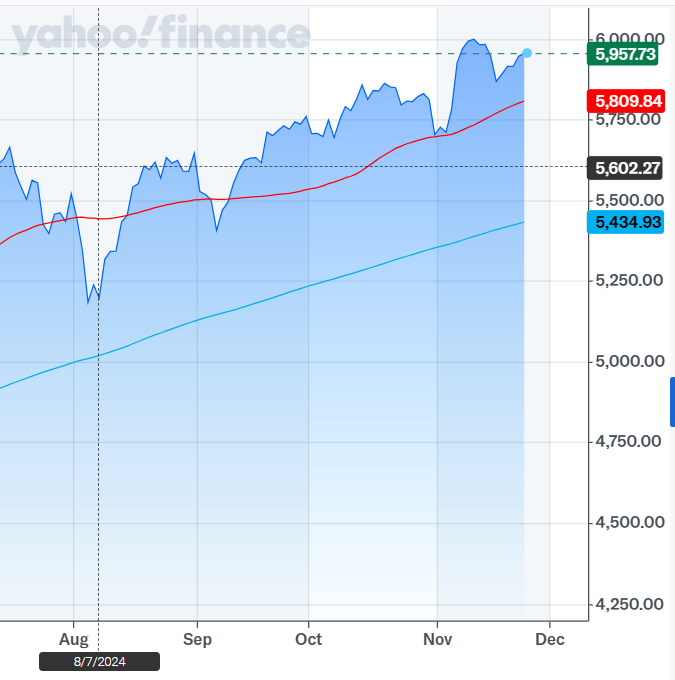
Source: Yahoo Finance
Of course, that can change, and we’ll continue to keep close eyes on that.
But while sentiment has been hit recently by political and geopolitical uncertainty, there remain signs of healthy underlying growth.
First years of a President’s term tend to be lackluster, but often better when it’s the first year of a second term.
Markets don’t need huge political wins or other economic boons to have a good, positive year. They just need reasonable sentiment and positive growth in an economy. Both of these appear to be present in today’s America.