


Ever wondered why budgeting rules of thumb are often based on percentages? In reality, how do we know that we value one line item by this much percent, and the other by that much? Does it reflect what really adds value to our lives? Understanding how to create a value-based budget addresses this very real question.
For many people living paycheck-to-paycheck, their spending habits aren't necessarily reckless. Their income may even be strong. But when they look at where their money goes, something feels off. They may even get the sense that they're too "plugged into the Matrix." At the end of the day, the numbers don't reflect their financial priorities. The structure doesn't reflect their values.
The lifestyle doesn't quite match the life they say they want.
This is where understanding how to create a value-based budget becomes powerful.
It's philosophy applied to money.
Why Most Budgets Drift Toward Lifestyle Creep
Traditional budgeting usually begins with historical spending.
You look at last month's numbers.
Adjust slightly.
And try to reduce what feels excessive.
But this approach assumes your current spending habits are already aligned with intentional living. And often, they're not.
Over time, lifestyle creep quietly resets your baseline. Raises become new obligations—you can no longer go backward and live without that raise. Upgrades become permanent, and what once felt optional becomes necessary for continued perception of well-being.
Without conscious spending, your budget becomes a record of momentum rather than intention.
And aimless momentum rarely leads to meaningful wealth on its own.
How to Create a Value-Based Budget (Starting With Priorities, Not Percentages)
If you want to understand how to create a value-based budget, you must flip the order of operations.
Instead of starting with categories and percentages, you start with reflection.
Before you assign a single dollar, write down what truly matters to you.
Ignore what social media promotes.
Don't compare with what your peers prioritize.
See past what advertising normalizes.
What actually matters to you?
Then divide your priorities into three groups:
- Needs
- Wants
- Hybrids
Note that often, needs and wants are combined within the same purchase.
A need might be shelter.
A want might be the size, location, or prestige of that shelter.
A need might be transportation.
A want might be the specific vehicle you drive.
What I call "hybrids" are especially important to consider. These are wants at their core but not strictly necessary for survival; however, they are deeply tied to quality of life. It's easy to categorize as one or the other, but real progress can be made when we understand the distinction even within the same good or service.
Once listed, rank these priorities. To help get you started, Tori at Her First $100k lists a few examples of such priorities.
Then estimate what it would realistically cost per month to fund or enjoy them.
This is the foundation of a budget based on priorities instead of percentages.
Needs vs Wants: The Most Misunderstood Distinction
The difference between needs vs wants is often oversimplified.
Needs are essential for survival and stability.
Wants are enhancements layered onto those needs.
But here's where it gets interesting:
Sometimes, a "want" attached to a need becomes so large that it crowds out what you truly value.
For example:
But a large mortgage (a want attached to shelter) reduces that flexibility.
You may value meaningful relationships.
But a demanding lifestyle tied to high fixed expenses limits your time.
When considering how to create a value-based budget, you must evaluate whether your "needs" are actually serving your highest lifestyle priorities — or quietly consuming them.
The Spending Pyramid: A Clear Framework for a Value-Based Budget
If you want to understand how to create a value-based budget, you need more than expense categories. You need order.
Think of your spending as a pyramid.
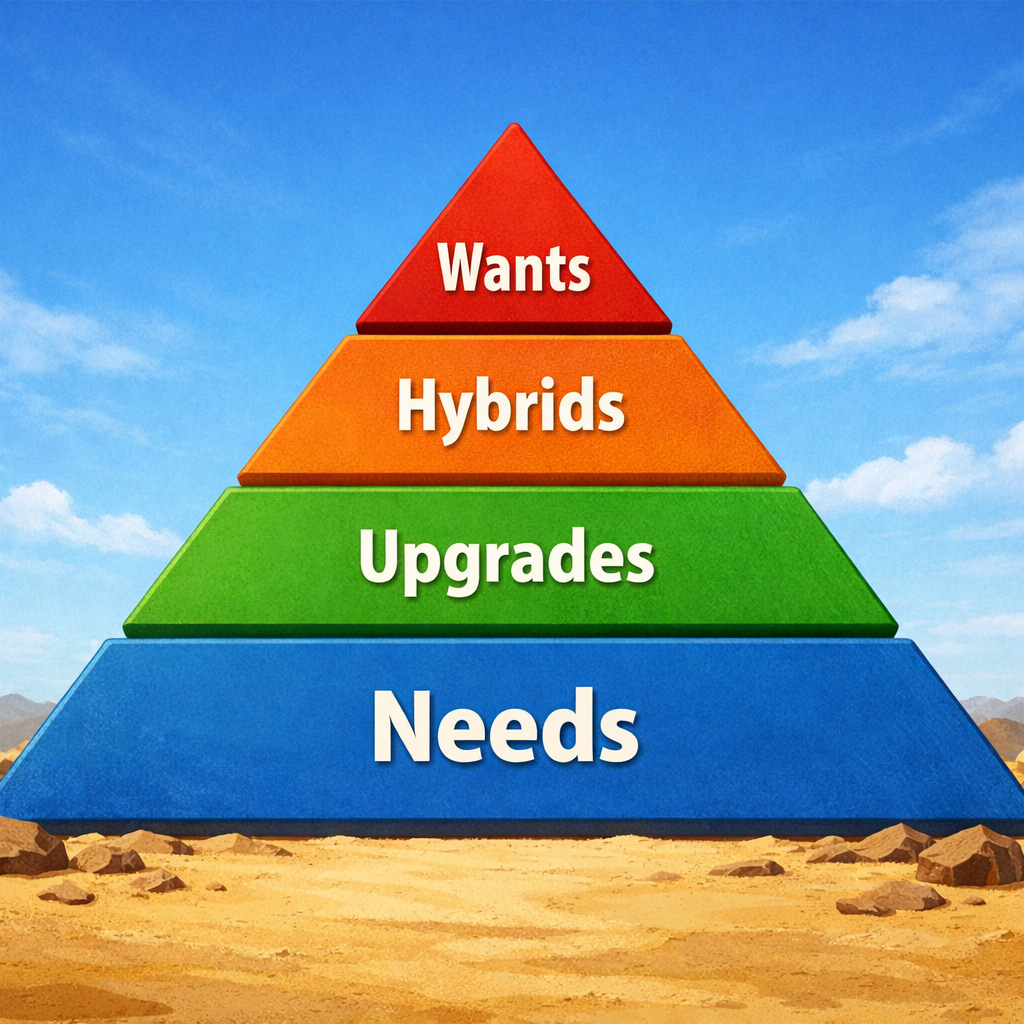
At the foundation is the single most important thing in your life — the expense that protects your well-being and enables everything else. This will likely be a need, because we must be well enough to want.
Start by listing your needs in order of priority. For each one, write down the lowest reasonable cost required to satisfy it adequately — not the luxury version, not the optimized version, but sufficiency. Define what "enough" looks like for housing, food, transportation, insurance, and basic utilities. This protects you from both lifestyle creep and unnecessary deprivation.
Next, list your wants also at their lowest reasonable cost. Rank them from most meaningful to least meaningful. When you're finished, you should have one unified list of needs and wants arranged from highest priority at the top to lowest at the bottom. This exercise forces clarity around your financial priorities and strengthens conscious spending.
Now return to your needs and ask: are there any you want to enhance? Perhaps a safer car, a more convenient location, higher-quality groceries, or faster internet. These are attached wants — discretionary upgrades that elevate foundational needs. Choose them intentionally rather than absorbing them unconsciously.
Then identify any hybrid wants. These are technically optional, but eliminating them would meaningfully reduce your quality of life. This might be a restorative annual trip, a creative outlet, or a fitness routine that supports long-term health. A value-based budget makes room for what sustains you, not just what keeps you alive.
Don't forget to create a line item for spontaneous, fun spending. You can still leave room for spontaneity within a plan.
Before allocating anything further, place savings, investing, and debt payoff near the top of your pyramid. Future security is not a leftover category. Funding your future is part of living a wealthy life.
Finally, if money remains, move down your list of pure wants and make upward adjustments deliberately. Upgrade in order of priority. If you run out of room before reaching the bottom, nothing is wrong. It simply means your higher values have already been funded.
not by cutting randomly, but by ranking intentionally.
Breaking Free From Conditioned Spending Habits
We live in a culture engineered to shape spending habits.
Advertising doesn't simply present options. It defines normal through repetition and through framing the underlying question. It can even present a false dichotomy.
If you're not careful, your wants become not examined desires, but absorbed defaults.
How do you interrupt that rhythm?
Some helpful resets include:
- Time alone in reflection
- Time in nature
- Exposure to other cultures
- A one-month spending fast
- Reading works like Walden, Life Without Principle or Quest of the Simple Life.
The goal isn't austerity.
It's clarity.
Because conscious spending requires awareness before adjustment.
And without awareness, even the best budgeting tools and strategies won't produce alignment.
How to Create a Value-Based Budget Without Ignoring the Future
There is an important tradeoff in value-based budgeting.
It can overweight the present.
When current enjoyment becomes the primary filter, it's easy to underinvest in sustainability — career growth, investing, retirement, family needs, or emergency reserves.
That's why learning how to create a value-based budget requires balancing:
- Present fulfillment
- Future stability
A purpose-driven budget must account for both.
You may value travel deeply and decide to allocate more toward vacations than early retirement savings.
That's not irresponsible. But it must be conscious.
And it must include guardrails that preserve long-term trajectory.
Intentional living doesn't mean ignoring tomorrow.
It means choosing today in a way that doesn't sabotage it.
Value-Based Budgeting vs Traditional and Zero-Based Budgeting
Traditional budgeting adjusts history.
Zero-based budgeting rebuilds from zero — but often toward material efficiency or financial maximization.
Value-based budgeting starts from a different place.
It asks:
It's less rigid — but more introspective.
It overlaps with zero-based budgeting methods in structure but differs in intent.
Before allowing expenses back into the rebuilt system, it demands clarity about meaningful wealth — not just numerical outcomes.
If you'd like a broader comparison of methods, you can review this article covering different types of budgeting methods.
Understanding the contrast sharpens your execution.
Practical Example: Vacation vs Early Retirement
Imagine two line items:
- Vacation
- Early retirement investing
In a zero-based system, each must justify itself financially.
In a value-based system, each must justify itself philosophically.
One person may heavily weight early retirement because autonomy matters most.
Another may allocate more to travel because living a wealthy life now — rich in experiences and relationships — ranks higher.
Neither is automatically correct.
The key is that the weighting is intentional.
That's how to create a value-based budget that reflects a deeper wealth beyond money.
When "Needs" Crowd Out Meaningful Wealth
Sometimes, your highest financial priorities are being squeezed by large fixed costs.
If that's the case, it may be time to evaluate where adjustments are possible.
You don't always need to slash lifestyle quality. Often, you can restructure intelligently.
Here's a guide on how to cut monthly expenses without sacrificing lifestyle.
Small structural changes can free up room for what matters most.
How to Create a Value-Based Budget That Evolves With You
Life stages change. And with those stages can emerge new leading values.
Whether it's marriage, children, career pivots, or health considerations — all reshape priorities.
As a result, creating a value-based budget isn't a one-time event. It's a periodic reset.
At least once per year, revisit:
- Your ranked priorities
- Your allocation patterns
- Whether your spending habits reflect intentional living
- Whether your definition of a wealthy life has evolved
And remember, it's okay if your values have rearranged. Don't feel glued to past values if they no longer reflect what you prioritize today. Sometimes, once we achieve a certain goal, we're ready for a new one.
A value-based budget is less about control and more about coherence.
It ensures your money moves in the same direction as your convictions.
Living a Wealthy Life Beyond the Spreadsheet
At its core, this conversation isn't about cutting back on last year's spending or optimizing percentages to fit a model.
It's about alignment that's uniquely suited to you. Because meaningful wealth isn't simply net worth.
It's coherence between:
- What you say matters
- How you live
- Where your money flows
Learning how to create a value-based budget gives structure to that coherence.
Value-based budgeting:
- Prevents lifestyle creep from silently defining your life for you.
- Interrupts unconscious spending habits.
- Strengthens financial priorities.
- Supports intentional living.
And perhaps most importantly, it allows your money to serve your values.
It allows you to break out of the rhythm and march to the beat of your own drum.
The goal is to live a wealthy life — one that reflects purpose, sustainability, and depth.
That's wealth beyond money.
And it starts with alignment.