


FINANCIAL TOOL
Standard Deviation
You may remember the bell curve from your high school or college statistics class.
It’s a nice little symmetrical bell that shows us how many data points show up around the average, and how few show up toward the less likely extremities.
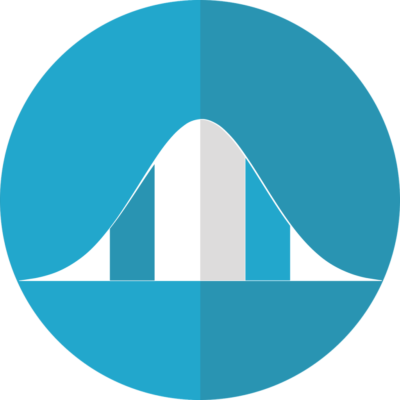
As a refresher, here’s the basic rule of thumb for a perfect bell curve:
- 68% of the data is contained within one standard deviation
- 95% of the data is contained within two standard deviations
- 99% of the data is contained within three standard deviations
So let’s take an overly simplistic view of what this means for stocks.
Let’s assume for a moment that stock returns have a perfect bell curve of returns (they don’t!). We’ll start simple.
Pretend XYZ stock has a 5-year average annual return of 15%.
Assume it also has a standard deviation of 18.
On a normal bell curve, we could infer that:
- 68% of years have ranged from 15% plus or minus 18% (-3% to 33%).
- 95% of years have ranged from 15% plus or minus 36% (-18% to 51%).
- 99% of years have ranged from 15% plus or minus 54% (-39% to 69%).
Now here’s the good news. Most stocks have what’s called a positive skew, meaning that the upside is more likely and frequent than the downside.
However, there are some extreme events on the downside that are also more likely to happen than what a normal bell curve would suggest.
So take it with a grain of salt.
But while there are outliers, standard deviation can offer you a good idea of what’s considered normal.
Add and subtract one standard deviation from the average to see if you’re comfortable with that range about 68% of the time.
Are you comfortable with 2x the standard deviation about 95% of the time?
Being familiar with these ranges can offer perspective and help you make disciplined decisions even in the years when markets encounter losses.